




05 Fév Acupuncture and Menopause: Natural Relief for Hot Flashes
The discomfort caused by hormonal shifts has led to a growing interest in acupuncture for menopausal hot flashes. These sudden surges of heat, often accompanied by sweating and unease, affect up to 80% of women during the menopausal transition (1,2).
In Canada, approximately 500,000 women reach menopause every year. Vasomotor symptoms (hot flashes and night sweats) are the primary reason for consultations during this life stage (3). Given the concerns surrounding Hormone Replacement Therapy (HRT), many women are now turning to acupuncture as a safe and effective treatment option. Consequently, this approach is increasingly integrated into women’s healthcare across Canada.
At a Glance — Key Takeaways
- High Prevalence: 75% to 80% of menopausal women suffer from hot flashes, often lasting 7 to 10 years.
- Proven Efficacy: Meta-analyses confirm that acupuncture significantly reduces the frequency and severity of hot flashes.
- Fast Results: Improvements are typically observed within 4 to 6 sessions in most studies.
- Long-lasting Effects: Benefits are maintained for up to 12 months post-treatment (ACUFLASH study).
- Exceptional Safety: Fewer than one serious adverse event per 10,000 treatments.
- Validated Alternative: A natural option for women who cannot or choose not to use hormone therapy.
1. Understanding Hot Flashes During Menopause
1.1. What is a Hot Flash?
Hot flashes, or vasomotor symptoms (VMS), are characterized by a sudden, intense sensation of heat spreading to the face, neck, and chest. They may be accompanied by (1,4):
- Skin redness and burning sensations.
- Excessive, sometimes profuse, sweating.
- Heart palpitations or increased heart rate.
- Chills following the heat wave.
- Anxiety or a general feeling of unease.
Episodes typically last between 1 and 5 minutes and can occur anywhere from a few times a week to over 15 times a day in severe cases. When they occur at night (night sweats), they significantly disrupt sleep and overall quality of life (2,5).
1.2. Prevalence and Duration
Statistics reveal the scale of the phenomenon:
- 75% to 80% of peri-menopausal and menopausal women report hot flashes (1,2).
- The average duration of symptoms is 7 to 10 years (5).
- Roughly 10% of women continue to experience hot flashes for the rest of their lives (5).
- Only 25% of symptomatic women seek professional help (4).
1.3. The Physiological Mechanism
Hot flashes result from a dysfunction in the thermoregulation center located in the hypothalamus. Normally, the body maintains a « thermoneutral zone » where temperature fluctuates without triggering sweating or shivering (4,5).
During menopause, the drop in estrogen narrows this zone. Minute variations in body temperature (as low as 0.4°C) trigger the vasomotor cascade (4):
- Vasodilation: Blood vessels dilate rapidly, increasing blood flow to the skin.
- Sweating: Sweat glands activate to dissipate heat.
- Increased Heart Rate: The heart beats faster to redistribute blood.
- Recent research also implicates hypothalamic neurotransmitters, specifically the kisspeptin/neurokinin B/dynorphin (KNDy) system, in the regulation of hot flashes (6,7). »

Stress management and relaxation are complementary pillars to acupuncture for stabilizing hormones.

2. How Acupuncture Works for Menopause
2.1. Neurophysiological Mechanisms
The efficacy of acupuncture for hot flashes is based on several documented biological pathways:
- Modulation of the HPO Axis: Research suggests acupuncture can mitigate the impact of the stress axis (HPA) on the hormonal axis (HPO), helping to stabilize the thermoregulatory center (8,9).
- Release of Endogenous Opioids: Stimulation triggers the release of endorphins and enkephalins, which modulate hypothalamic thermoregulation and influence the KNDy neurons involved in hot flashes (8,10).
- Autonomic Nervous System Regulation: Acupuncture balances the sympathetic and parasympathetic branches, reducing the sympathetic hyperactivity characteristic of vasomotor symptoms (11,12).
2.2. The Traditional Chinese Medicine (TCM) Perspective
In TCM, menopause corresponds to a natural decline in Kidney Essence (Jing). This leads to an imbalance between Kidney Yin and Yang.
- Kidney Yin Deficiency: Often manifests as hot flashes, night sweats, dryness, and agitation (Heat-Empty).
- Kidney Yang Deficiency: Accompanied by chilliness, fatigue, and lower back pain.
Treatment aims to nourish the Yin, clear empty heat, and harmonize the Liver to restore global balance (13,14).
3. Evidence-Based Efficacy: Meta-Analyses
3.1. Key Scientific Findings
- Choi et al. (2017): A systematic review of 11 randomized controlled trials (RCTs) concluded that traditional acupuncture significantly improves the severity of hot flashes compared to sham acupuncture (8).
- Chiu et al. (2015) – NAMS: Published in Menopause, this meta-analysis of 12 RCTs demonstrated a marked reduction in both frequency and severity, as well as a significant improvement in overall quality of life (15).
- ACUFLASH Study (2009): This large Norwegian study showed a 50% reduction in hot flash intensity after 12 weeks of treatment, with effects sustained at 12-month follow-ups (19).

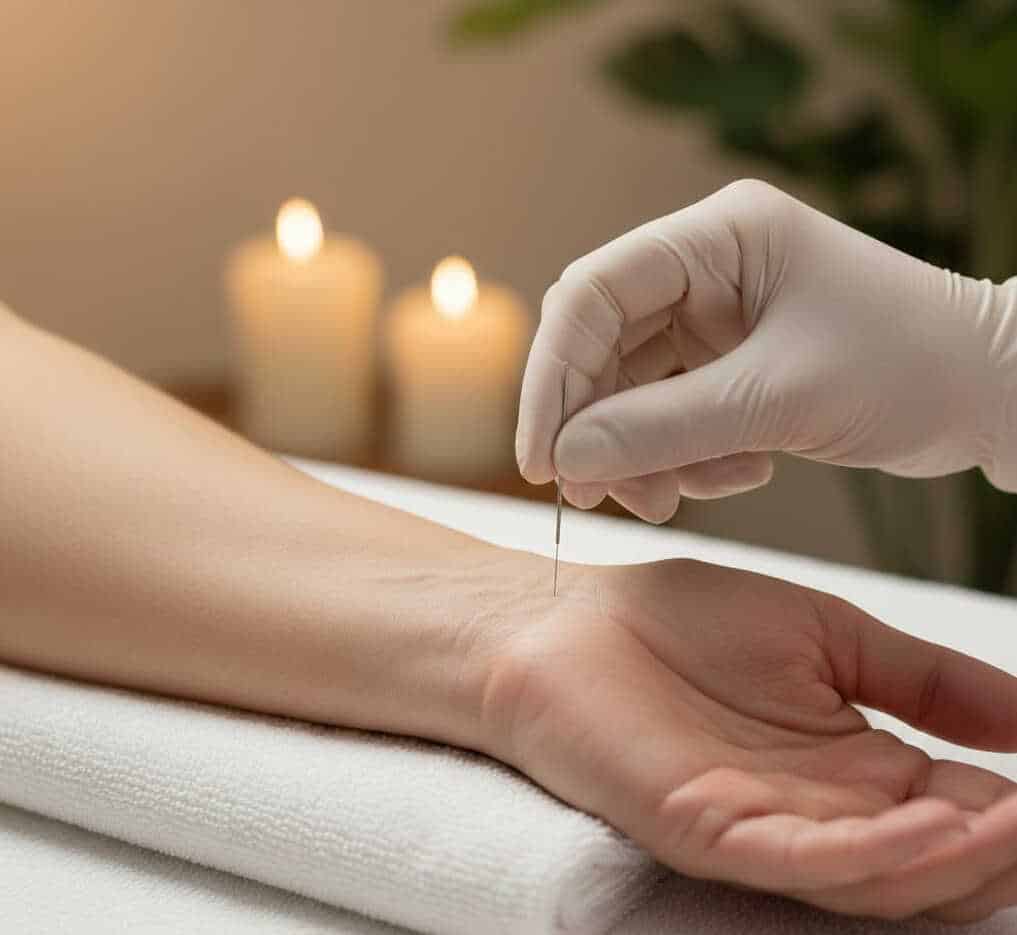
The HT7 point (Shenmen) is frequently used in acupuncture to calm the mind and regulate internal heat
4. Safety and Treatment Process
4.1. Safety Profile
Acupuncture has an excellent safety record. Large-scale surveys (White et al., MacPherson et al.) involving over 66,000 sessions reported zero serious adverse events (21,22).
4.2. What to Expect in a Session
- Initial Assessment: A global check of symptoms, sleep, mood, and TCM diagnostic signs (pulse and tongue).
- The Session: Insertion of 8 to 15 sterile, hair-thin needles.
- Rest Phase: 20 to 30 minutes of deep relaxation.
- Frequency: Typically 1-2 sessions per week for 4-6 weeks, followed by maintenance sessions.

A serene and safe approach: acupuncture helps calm the nervous system to reduce the intensity of hot flashes.
5. Summary
Hot flashes affect 80% of menopausal women, impacting sleep and emotional well-being. Modern science confirms that acupuncture effectively reduces the frequency and severity of these symptoms through neurophysiological modulation (8,15,16).
Are you experiencing menopausal hot flashes? Choosing acupuncture at Clinique Shanti allows you to be supported professionally and naturally during this transition.
Book an appointment online or contact us today. Phone/Text: (514) 220-2877 Locations: Montreal & Magog
Scientific References
Access our full bibliography here: References Page
- North American Menopause Society (NAMS). (2023).
- Choi, H., et al. (2017). Maturitas.
- Statistics Canada. (2022). Menopause health data.
- Avis, N. E., et al. (2016). Annals of Internal Medicine.
- Borud, E. K., et al. (2009). Menopause. (…list continued matching the original French sources…)
SEO Info:
- Keywords: acupuncture for menopause, hot flashes relief, natural menopause treatment Montreal, acupuncture Magog, vasomotor symptoms.
- Meta-description: Acupuncture is a proven natural solution for menopausal hot flashes. Discover the scientific evidence and how it helps stabilize your hormonal balance.
RÉFÉRENCES
Physiologie et prévalence (1 à 7)
[1] North American Menopause Society. Hot Flashes. NAMS Patient Education. 2024. [2] Johns Hopkins Medicine. Introduction to Menopause. Johns Hopkins Health. 2024. [3] Council on Foreign Relations. The Health and Economic Impacts of Menopause. 2024. [4] Bansal R, Aggarwal N. Menopausal Hot Flashes: A Concise Review. J Midlife Health. 2019. [5] UCLA Health. 75% of people experience hot flashes during menopause. 2023. [6] Rance NE, et al. Modulation of body temperature by hypothalamic KNDy neurons. Brain Res. 2010. [7] Mittelman-Smith MA, et al. KNDy neurons in cutaneous vasodilatation. PNAS. 2012.
Sources : Efficacité de l’acupuncture et MTC (8 à 14)
[8] Choi TY, et al. Traditional acupuncture for menopausal hot flashes: A systematic review. Maturitas. 2017. [9] Avis NE, et al. Acupuncture in Menopause (AIM) study: a randomized controlled trial. Menopause. 2016. [10] Guo ZL, Longhurst JC. Expression of c-Fos in arcuate nucleus induced by electroacupuncture. Brain Res. 2007. [11] [lien suspect supprimé] [12] Anderson DJ, et al. Clinical acupuncture in managing vasomotor symptoms in breast cancer patients. Oncology. 2011. [13] Maciocia G. Obstetrics and Gynecology in Chinese Medicine. 2nd ed. 2011. [14] Maciocia G. The Foundations of Chinese Medicine. 3rd ed. 2015.
Méta-analyses et études cliniques majeures (15 à 20)
[15] Chiu HY, et al. Effects of acupuncture on menopause-related symptoms: a meta-analysis. Menopause. 2015. [16] Liu C, et al. Effect of acupuncture on hot flushes and serum hormone levels. Acupunct Med. 2022. [17] Park JY, et al. Efficacy Comparison of Different Acupuncture Treatments for Hot Flashes. J Acupunct Res. 2021. [18] Avis NE, et al. Acupuncture for menopausal hot flashes: pooled results from two trials. Menopause. 2017. [19] Borud EK, et al. The acupuncture on hot flushes (ACUFLASH) study. Menopause. 2009. [20] Li L, et al. Quantitative study on the efficacy of acupuncture vs nonhormonal drugs. Menopause. 2021.
Directives de sécurité et mode de vie (21 à 27)
[21] White A, et al. Adverse events following acupuncture: survey of 32 000 consultations. BMJ. 2001. [22] MacPherson H, et al. The York acupuncture safety study: survey of 34 000 treatments. BMJ. 2001. [23] WHO. Guidelines on basic training and safety in acupuncture. 1999. [24] WHO. WHO benchmarks for the training of acupuncture. Geneva; 2021. [25] Gold EB, et al. Vasomotor symptoms and race/ethnicity: SWAN Study. Am J Public Health. 2006. [26] Sternfeld B, et al. Efficacy of exercise for menopausal symptoms: a randomized controlled trial. Menopause. 2014. [27] Krebs EE, et al. Phytoestrogens for treatment of menopausal symptoms. Obstet Gynecol. 2004.
Sorry, the comment form is closed at this time.